Release date
Messages from Ny-Ålesund 2025: Biology Edition
Ny-Ålesund NIPR Observatory in Norway serves as one of the international collaboration sites for the ArCS III project. As the observation season begins, many research teams once again visited Ny-Ålesund for their field studies. Here, we share a look at the ecosystem observations conducted this summer. The “Aerosols Edition” is also available, so please take a look.
Author: Masaki Uchida (NIPR)
The summer field season has begun once again. After a long break, several teams are coming to Svalbard this year. They will rotate in and out for their respective research projects.
Before heading to Ny-Ålesund, our group travelled to Longyearbyen to make some observations. We flew into Svalbard Airport, which is the northernmost airport with regular commercial flights. It is located just before Ny-Ålesund on the route. Despite the overcast sky, we caught a brief glimpse of the glaciers as the plane descended (Photo 1). We started our survey work in Longyearbyen, taking care not to disturb the barnacle geese that had already settled there to raise their chicks (Photo 2).


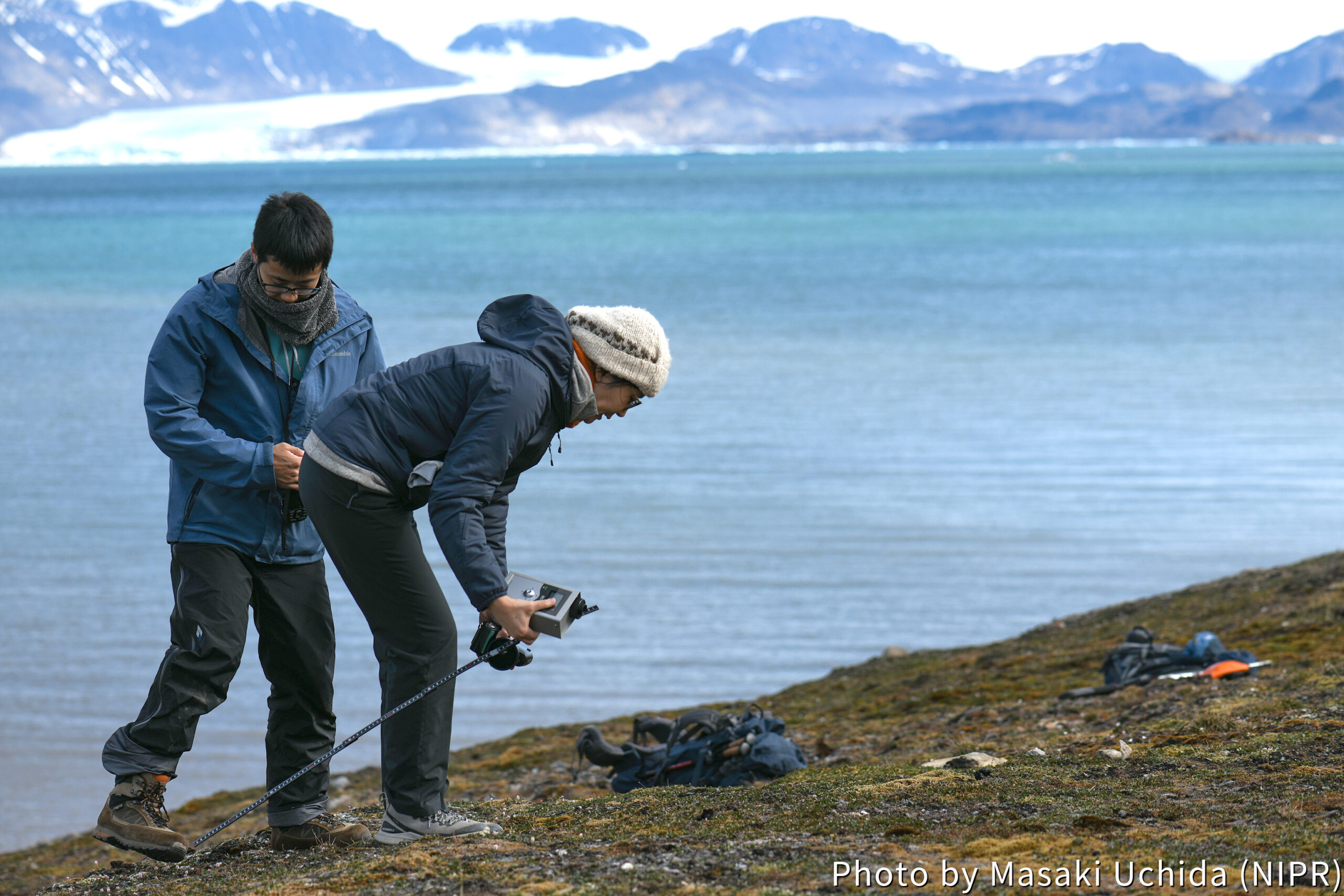
Our first task was to estimate surface conditions over a wide area using satellite-derived data. Due to the variety of vegetation on the ground surface, we documented representative sites by taking photographs, measuring optical reflectance similar to that observed by satellites, and identifying plant species and their abundance (Photo 3). As it was the observation within the town area, we carried out our measurements while passing colorful and charming houses (Photo 4).


After completing our fieldwork in Longyearbyen, we moved on to Ny-Ålesund. Although the weather remained cloudy, we still saw the impressive Kongsbreen Glacier during our flight (Photo 5).

Our first assignment in Ny-Ålesund was to assist a study by researchers from Waseda University with their study of investigating plant roots. Their research focuses on the amount and types of organic compounds exuded from roots into the surrounding soil (Photo 6).
Setting up the equipment needed for the root exudate experiment took half a day, followed by two days of retrieving the devices. This cycle will be repeated three times during our stay. We also conducted the same surface survey as in Longyearbyen. Despite being only about 100 km apart, the ground surface conditions in the two locations differ noticeably, so we collected data at several dozen sites (Photo 7).
We have researchers and students from Hokkaido University visiting Ny-Ålesund for the first time to study Arctic plants. Using satellite data as indicators of plant photosynthetic productivity, they aim to improve the accuracy of productivity estimates derived from satellite observations by measuring the same indicators directly on small Arctic plants in the field (Photo 8).

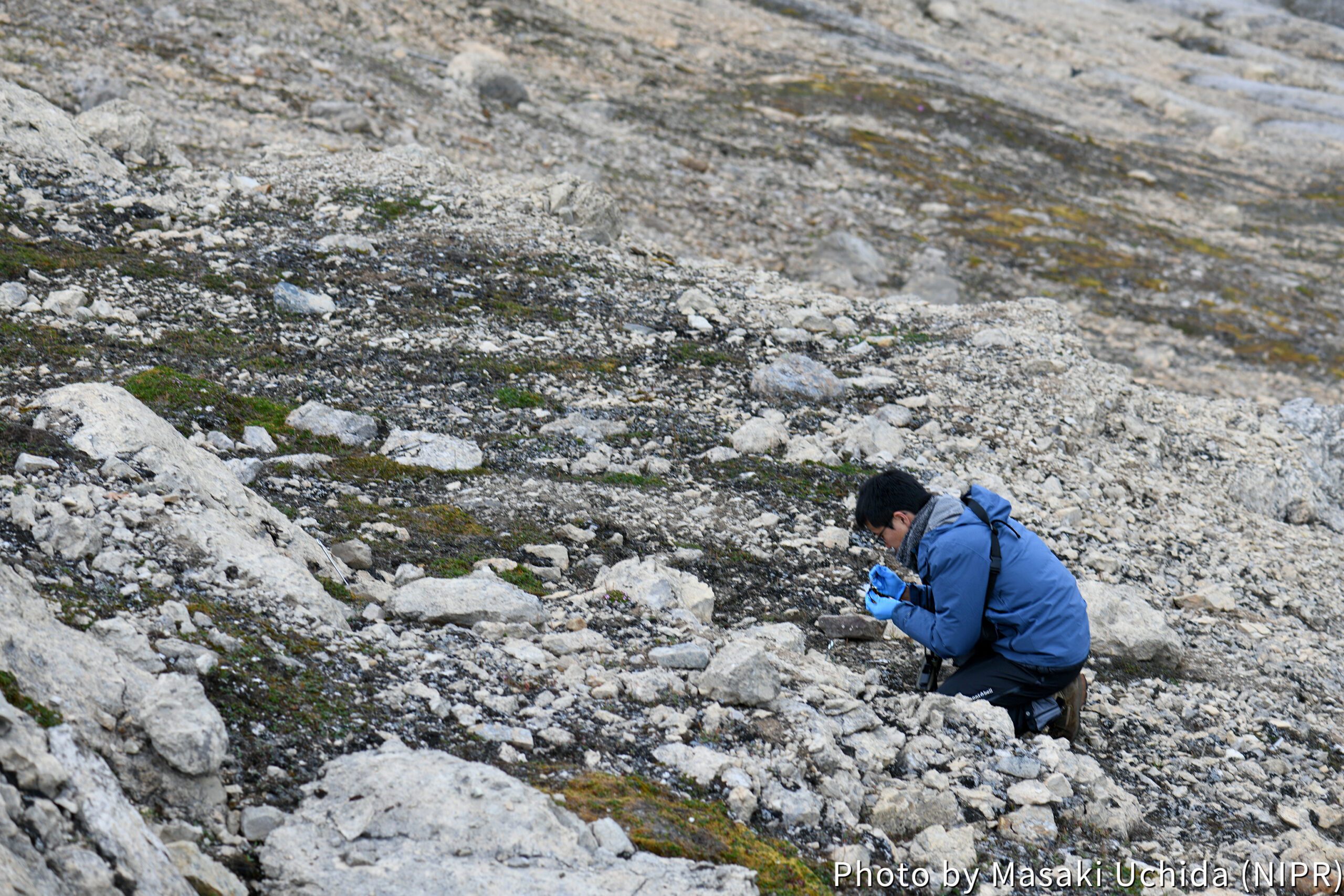
A graduate student from the Graduate University for Advanced Studies (SOKENDAI) began investigating the influence of nesting migratory birds on soil microbial diversity. To avoid contaminating samples with human-carried microorganisms, soil and plant surveys were conducted while wearing gloves and masks (Photo 9).

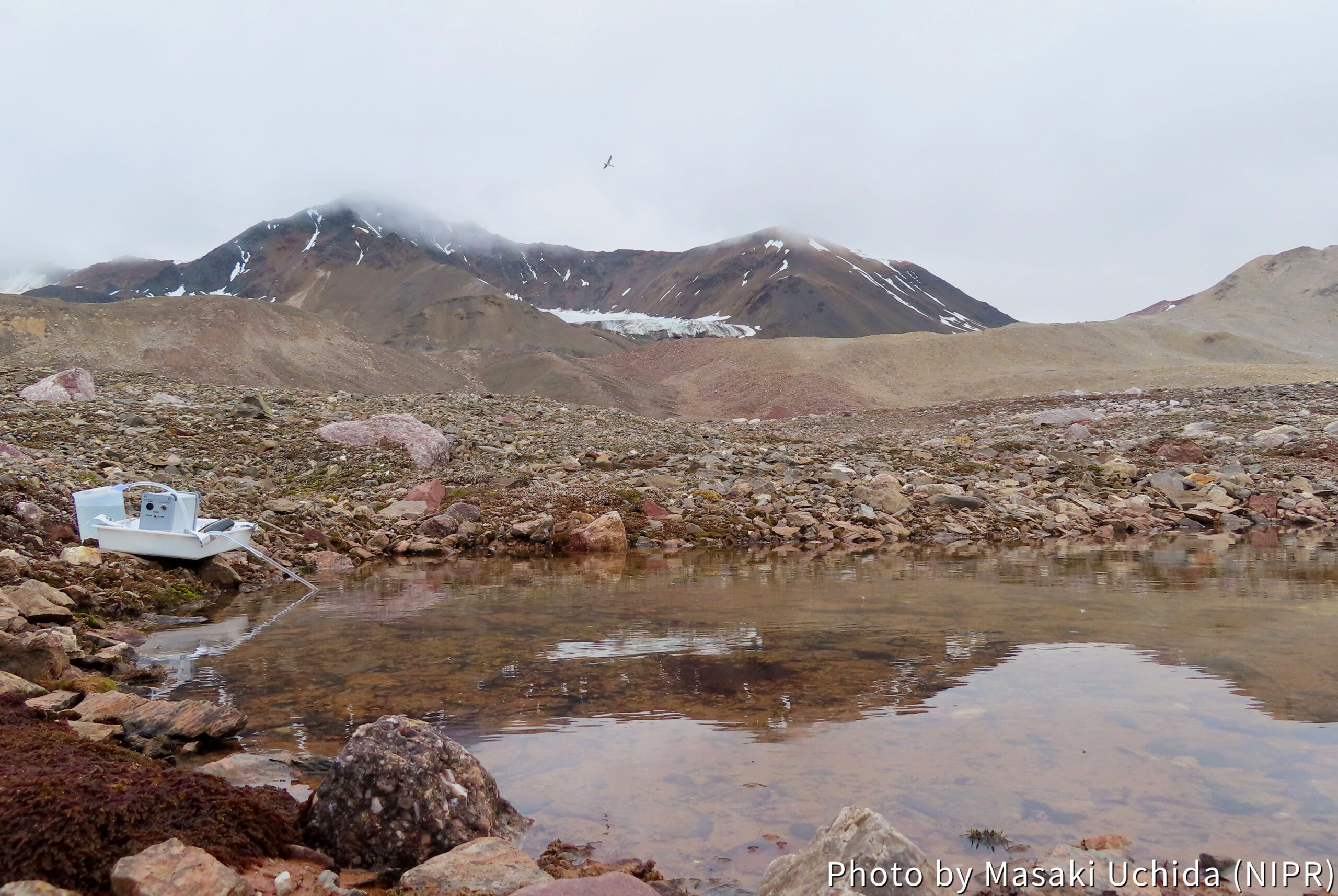
There are numerous ponds of various sizes scattered around glaciers. To study the functions of the microorganisms inhabiting these ponds, environmental DNA was collected from the water. We drew water from the ponds using a sterilized straw attached to a pump and captured the DNA on a special filter (Photo 10). To prevent degradation, we froze the filters immediately and transported them back to Japan.