
Release date
Kickoff Workshop Report for ICAARUS: A Japan-Switzerland Joint International Program
Post Date:
Author: Atsushi Yoshida (NIPR)
A kickoff workshop for ICAARUS (In situ Cloud-Aerosol interaction in the ARctic using Uncrewed Systems) was held at the École Polytechnique Fédérale de Lausanne (EPFL) in Sion, Switzerland, over three days from to .
ICAARUS is a joint international research program between Japan and Switzerland that aims to unravel the vertical structure of cloud-aerosol interactions through in-situ observations in the rapidly warming Arctic region, utilizing uncrewed systems such as tethered balloon systems (Helikite) and drones. I participated in this project as an early career scientist, observing the atmospheric observation project using Helikite led by Switzerland and deepening exchanges with Swiss researchers and engineers through classroom lectures and meals.
What strongly impressed me during the classroom lecture on the Helikite was the close collaborative system between engineers and scientists at EPFL. This is a system rarely seen in Japan, and I felt very envious of it. The Helikite’s payload includes various measuring instruments, but through their own development, it has excellent scalability in both software and hardware. This flexible instrument development is exactly what can be achieved because of the collaborative system, and it has become a strength that greatly expands the scope of research. Furthermore, many of the people who will operate it as operators in the field, such as in the Arctic in the future, were inexperienced. Therefore, to ensure that the mechanism of the Helikite does not become a mere black box, it was impressive that very detailed and careful explanations were given, from the theory of the system to the mechanism of safety management.
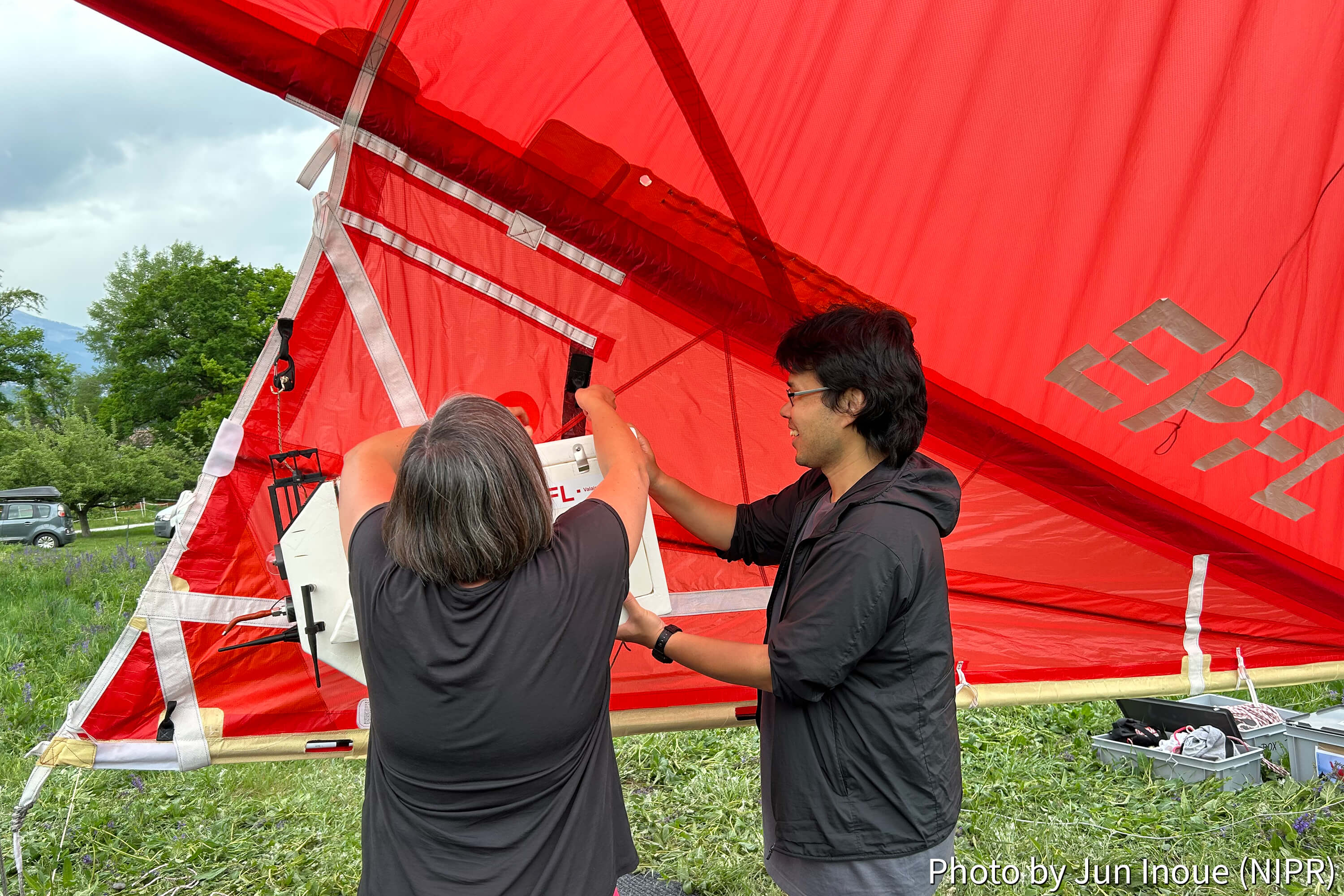
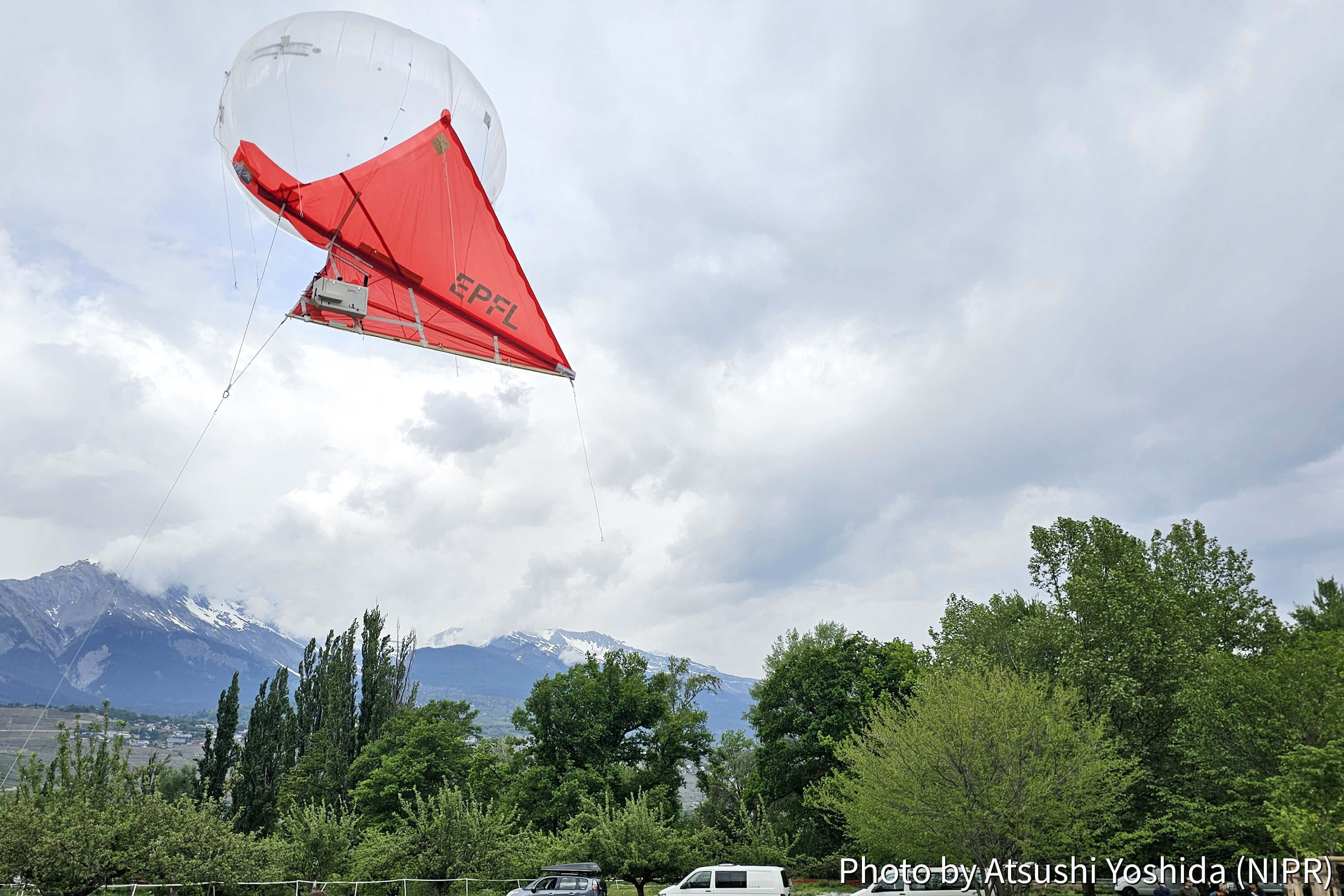
During the outdoor practical training, Dr. Kazutoshi Sato (NIPR), who will serve as one of the operators on the Japanese side, took the lead in hands-on operations (Photo 1). It was spectacular to see the huge Helikite, loaded with various observation instruments, inflate and rise into the sky (Photo 2). As a researcher, I was deeply moved to see instruments that are usually only seen operated on the ground or on ships being attached to the Helikite, rising far into the sky, and acquiring valuable atmospheric profile data.
On the final day, a meeting on future project policies was held, centered around Prof. Jun Inoue (NIPR), representing the Japanese side, and Prof. Julia Schmale (EPFL), representing the Swiss side. Enthusiastic discussions were held on what can be done by leveraging the strengths of both countries and what kind of science can be achieved. Both sides showed their past research achievements and the status of ongoing projects (such as Japan’s ArCS III project). I keenly realized that the steady accumulation of past achievements is important to win the trust of the other party to make international joint research successful, and at the same time, I thought that I myself want to do good science from now on to gain international trust.
-
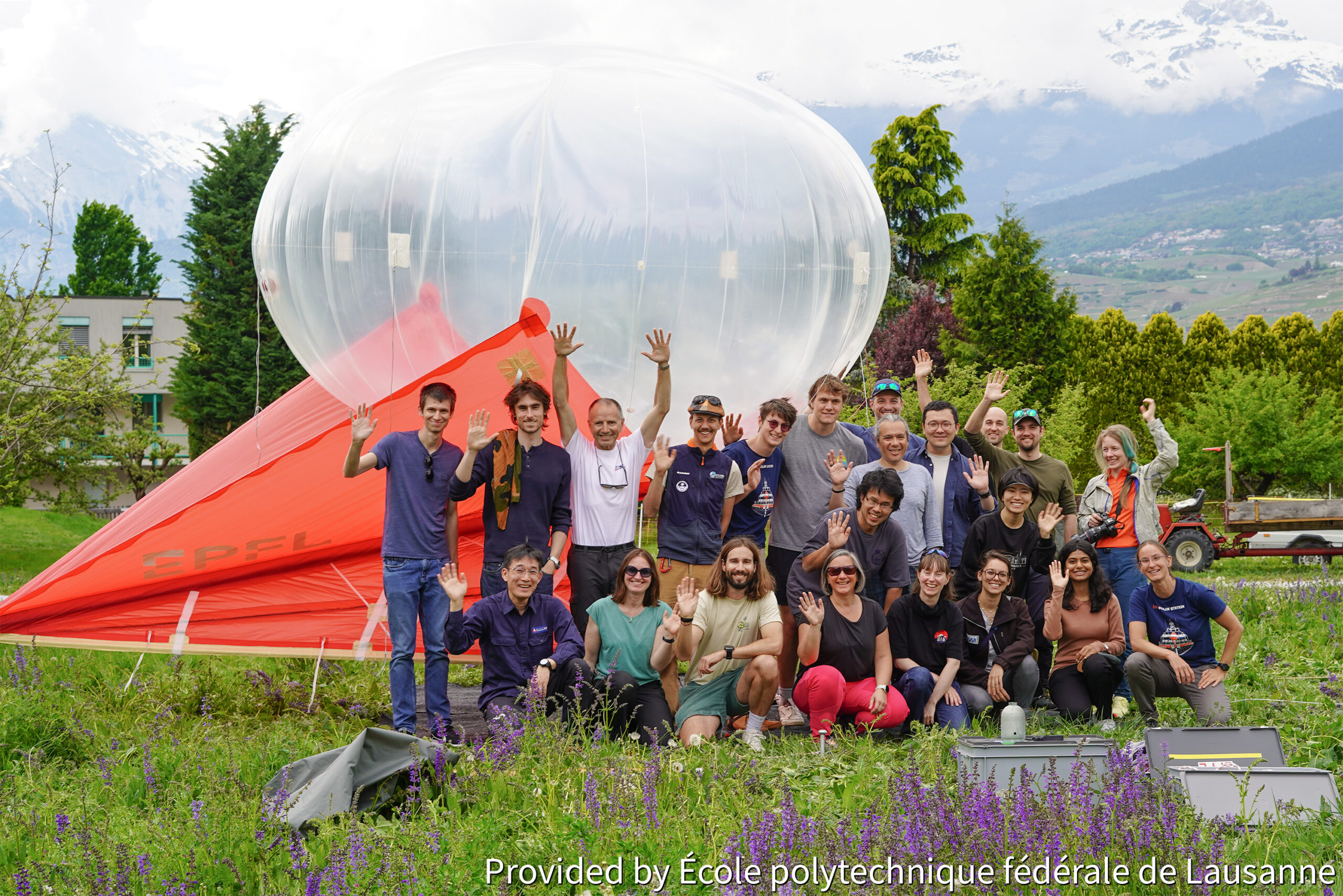 Group photo in front of the Helikite